
Arizona · Handbook chapter 5 · 4 min read
Chapter 5: Signals, signs and pavement markings
Arizona traffic lights and arrows, dark signals, sign shapes and colors, railroad crossings, mile posts, work zones where fines double, and the meaning of every line and curb color.
Why this chapter matters
Signals, signs and markings appear on every permit test, and in a dust storm or heavy rain a sign's shape may be all you can see. Know what each color, shape and line means.
Traffic lights
| Signal | What to do |
|---|---|
| Steady green | Go if the way is clear; yield to vehicles already in the intersection |
| Steady yellow | Red is coming: stop safely if you have not entered; if you are in, clear the intersection |
| Steady red | Stop before the stop line or crosswalk; right turn allowed after a full stop unless a sign forbids it |
| Flashing red | Same as a STOP sign |
| Flashing yellow | Slow down and go with caution |
| Red arrow | No turn in that direction until green |
| Yellow arrow | About to turn red: stop if you have not entered |
| Flashing yellow arrow | Turn with caution after yielding to oncoming traffic and pedestrians |
| Green arrow | Go in the arrow's direction from the proper lane |
Speeding up to beat a yellow light is illegal. Obey a police officer directing traffic over the signal.
A signal that is dark is treated as a four-way stop: stop, then go when clear, and the vehicle on the left yields to the one on the right.
Sign shapes and colors
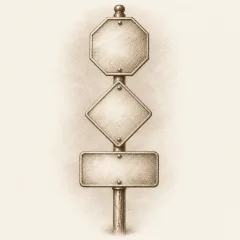
- Octagon: STOP only. Come to a complete stop.
- Triangle (point down): YIELD to cross or merging traffic.
- Rectangle: regulatory signs for speed, direction and turns, such as NO U TURN or NO LEFT TURN. White speed limit signs show the legal maximum.
- Pennant: the start of a no-passing zone.
- Diamond (yellow): a possible danger ahead, such as a merge, crossroad or curve. Small yellow plaques under curve signs show the safe speed for the curve.
- Pentagon: school crossing; children may cross at any time of day. Many districts use yellow-green.
- Circle (yellow): a railroad crossing is ahead.
- Orange: road work.
- Green, blue and route shields: guide signs. Arizona state highways have mile posts about 1 mile apart, set 2 feet off the right shoulder; use them to tell responders where you are.
Railroad crossings
The white crossbuck marks the crossing itself. Stop no closer than 15 feet from the nearest track when lights flash, bells ring, the gate is down or a flagger signals. Wait until the signals stop and the gate is all the way up; never drive around or under it.
- Expect a train on any track at any time, and look for a second train.
- Never get trapped on the tracks, and get out if your car stalls there.
- Buses and gasoline tankers must stop at crossings, so be ready.
Work zones
- Orange is the color of work zone signs and devices, and most work signs are diamonds.
- Fines double for violations in posted Arizona work zones.
- Flaggers in orange vests use red flags or STOP/SLOW paddles.
- Flashing arrow panels tell you to move into another lane in the arrow's direction.
- Cones, drums and barricades guide you through and may carry lights at night.
Pavement markings
- Yellow lines separate traffic going in opposite directions. White lines separate lanes going the same way and mark edges, stop lines and crosswalks.
- Broken yellow: passing allowed when clear.
- Solid plus broken yellow: you may pass only if the broken line is on your side.
- Double solid yellow: no passing either way; cross only to turn left.
- Broken white: may be crossed after signaling.
- Solid white: marks turn lanes, the right edge, and discourages lane changes near intersections. You may cross it to enter or leave an HOV lane, or at the right edge in an emergency.
- Double solid white: crossing is prohibited.
- Double dashed yellow: a reversible lane; check signs for its direction.
- A curved arrow with ONLY means you must turn that way; curved plus straight arrows let you choose.
- A painted bicycle means watch for bicyclists.
Curb colors
| Curb | Meaning |
|---|---|
| White | Stop only to pick up or drop off passengers |
| Yellow | Stop only to load or unload; stay with the car |
| Red | No stopping, standing or parking |
Frequently asked questions
What does a flashing red light mean?
The same as a STOP sign: stop completely, then go when the way is clear.
What should I do at a traffic signal that is out?
Treat it as a four-way stop.
How close can I stop to railroad tracks?
No closer than 15 feet from the nearest track.
Do fines really double in work zones?
Yes. Where signs are posted, fines for violations in Arizona work zones are doubled.
What does a yellow curb mean?
You may stop only long enough to load or unload, and you must stay with the car.
Based on the Arizona Driver License Manual (ADOT MVD, revised September 2026), Section 3.