
New Hampshire · Handbook chapter 7 · 5 min read
Chapter 7: Signals, signs and pavement markings
New Hampshire traffic signals and arrows, sign colors and shapes, warning, regulatory, route, guide, railroad and work zone signs, and the meaning of lines, stop lines, crosswalks and arrows on the road.
Why this chapter matters
Signs, signals and markings make up a big share of any knowledge test. Learn the colors and shapes and you can read a sign before you are close enough to see its words.
Who to obey first
Traffic control devices include signals, signs, markings and directions from police, highway workers and school crossing guards. A police officer directing traffic overrules any light or sign.
Traffic signals
| Signal | Meaning |
|---|---|
| Solid green | Go if the way is clear, yielding to pedestrians and vehicles in the intersection |
| Solid yellow | The light is about to turn red |
| Solid red | Stop before the stop line, crosswalk or intersection and wait for green. You may turn right on red after stopping unless a sign forbids it |
| Flashing yellow | Slow down and go with caution, ready to stop |
| Flashing red | Stop completely, then go when safe, yielding as required |
| Green arrow | Turn that way after yielding to traffic and pedestrians |
| Yellow arrow | Slow down and turn with caution |
| Red arrow | Do not enter the intersection for that movement |
Sign colors
| Color | Meaning |
|---|---|
| Red | Prohibition (stop, or do not) |
| Green | Direction or guidance |
| Blue | Driver services |
| Yellow | General warning |
| White | Law or rule of the road |
| Orange | Road work warning |
| Brown | Tourist and recreation guidance |
| Pink | Incident management |
| Purple | E-ZPass |
Sign shapes
| Shape | Meaning |
|---|---|
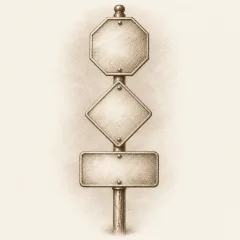
| Octagon (8 sides) | Stop |
| Downward triangle | Yield |
| Pennant (sideways triangle, on the left side of the road) | No passing zone ahead |
| Diamond | Warning of a special hazard ahead |
| Rectangle | Regulations or directions |
| Pentagon (5 sides) | School zone and school crossing |
| Circle | Advance warning of a railroad crossing |
| Crossbuck (X) | Where the railroad crossing is |
Key signs
- STOP: stop completely (wheels not moving) behind the stop line or crosswalk, or before the intersection if there is neither; look both ways and yield.
- YIELD: a red and white downward triangle; slow down and let traffic with the right-of-way go first.
- Warning signs (yellow): curves, intersections, merges, lane ends, signals or stops ahead, pedestrians, bicycles, slippery road and similar.
- Regulatory signs (white): lane use, turns, speed, parking. A red circle with a slash forbids what it shows. The speed limit sign shows the most you may drive in ideal conditions.
- Shared center lane left turn only: for left turns from either direction, never for through traffic or passing.
- Route numbers: on interstates, even numbers run west-east and odd numbers north-south. A three-digit route with an odd first digit goes into a city; an even first digit goes through or around it.
- Guide signs are green, brown or blue: destinations, points of interest and services.
Railroad crossings
- A round yellow sign with an X and RR comes before a crossing: slow down, look and listen.
- When a train is coming, stop at the stop line, or between 15 and 50 feet from the nearest rail. Wait until the lights stop flashing or trains have passed; with more than one track, wait until you can see clearly both ways.
- Cross quickly without stopping on the tracks.
- Buses carrying passengers and trucks with flammable or hazardous loads must stop at every crossing, so be ready to stop behind them.
Work zones
Work zone signs are usually orange diamonds or rectangles with black letters. Follow flaggers, slow down, do not tailgate, and expect barrels, cones and temporary signals. Fines may be doubled where posted.
Pavement markings
- White lines separate traffic moving the same direction; yellow lines separate traffic moving in opposite directions.
- Broken lines: you may pass or change lanes when safe.
- Solid white: do not change lanes or pass.
- Double lines: if the line on your side is solid, do not pass; if it is broken, you may pass when safe.
- Edge lines: white on two-way roads and on the right edge of one-way roads; yellow on the left edge of one-way roads.
- Stop line: stop there first. With no stop line, stop before the crosswalk; with neither, stop before the intersection.
- Crosswalks: yield to pedestrians in marked crosswalks and at intersections even when no lines are painted.
Frequently asked questions
Can I turn right on red in New Hampshire?
Yes, after a full stop, unless a sign prohibits it.
What does a brown sign mean?
Tourist and recreation guidance.
What does a purple sign mean?
E-ZPass.
How far from a railroad track should I stop for a train?
At the stop line, or between 15 and 50 feet from the nearest rail.
What does a pennant-shaped sign mean?
A no passing zone ahead. It stands on the left side of the road.
Based on Section 6 of the New Hampshire Driver's Manual (NH Division of Motor Vehicles).