
Pennsylvania · Handbook chapter 2 · 10 min read
Chapter 2: Signals, signs and pavement markings
Pennsylvania traffic lights, arrows and flashing signals, ramp meters and lane-use signals, sign shapes and colors, regulatory, warning, work zone and guide signs, interstate numbers, mile markers and pavement lines.
Why this chapter matters
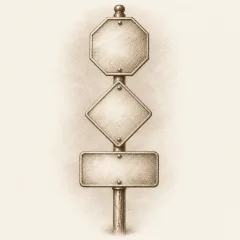
Many permit questions show a sign or describe a signal. The shape and color of a sign tell you its type before you can read it, so learn the shapes first, then the meanings.
Traffic lights
When signals are stacked vertically, red is on top and green at the bottom. When they are side by side, red is on the left and green on the right.
| Signal | What to do |
|---|---|
| Steady red | Stop before the stop line or crosswalk (or before the intersection if there are no lines) and wait for green |
| Steady yellow | Red is coming: slow and prepare to stop. If you are already in the intersection or cannot stop safely, go through carefully |
| Steady green | Go if the road is clear. You may turn unless a sign forbids it, but yield to vehicles and pedestrians already in the intersection |
| Steady red arrow | Stop; no turn in that direction. Wait for a green arrow or flashing yellow arrow. The same turns on red allowed at a red light are allowed here |
| Steady yellow arrow | The arrow phase is ending; prepare to stop |
| Steady green arrow | Turn the way it points. The turn is protected because oncoming traffic has red |
| Flashing red | Same as a STOP sign: stop completely, look, then go when clear |
| Flashing yellow | Caution: slow down and proceed carefully |
| Flashing yellow arrow | You may turn after yielding to oncoming traffic and pedestrians. The turn is not protected |
If a green arrow changes to a plain green light, you may still turn, but now you must yield to pedestrians and oncoming traffic.
Turning on red
- Right on red is allowed after a full stop, unless a NO TURN ON RED sign is posted. Yield to pedestrians and traffic first.
- Left on red is allowed only from the left lane of a one-way street onto another one-way street, after stopping, unless a sign forbids it.
Signals that are out
Treat a traffic signal that is not working as a four-way stop.
Ramp meters
Some entrance ramps have signals that alternate red and green during rush hours. Wait for green. On a single-lane ramp, only one car goes on each green. Green does not protect you: you still need a safe gap.
Lane-use control signals
Found over lanes at toll plazas, bridges, tunnels and reversible city lanes:
- Green downward arrow: you may use the lane.
- Steady yellow X: the lane is about to reverse direction. Move out of it safely.
- Steady red X: do not use the lane.
- White one-way left-turn arrow: the lane is for left turns only.
- White two-way left-turn arrow: left turns only, and drivers from the opposite direction share the lane.
Pedestrian, school and railroad signals
- A steady WALK (walking person) means pedestrians may start, watching for turning vehicles. A flashing DON'T WALK (flashing hand) means finish crossing if already in the street, but do not start. A steady DON'T WALK means do not cross.
- Always yield to pedestrians, and slow down and yield to a blind pedestrian with a white cane or guide dog.
- School zone signals are flashing yellow lights on the school speed limit sign. The limit is 15 mph while they flash or during the posted times. Speeding in a school zone brings 3 points and a fine.
- At a railroad crossing you must stop for flashing red lights, a lowered gate, a flagger or a train's horn. Never go around a gate, and never stop on the tracks.
Sign shapes and colors
Pennsylvania signs fall into three groups: regulatory, warning and guide.
| Shape or color | Meaning |
|---|---|
| Octagon (8 sides), red | STOP: the only octagon on the road |
| Triangle pointing down | YIELD |
| Pennant (sideways triangle) | NO PASSING ZONE: the only pennant-shaped sign, on the left side of the road |
| Pentagon | SCHOOL: the only pentagon |
| Diamond, yellow with black | Warning of a hazard or change ahead |
| Diamond, orange with black | Work zone |
| Round, yellow | Railroad crossing ahead |
| Rectangle, black and white | Most regulatory signs, such as SPEED LIMIT |
| Green with white letters | Highway and expressway guide signs |
| Blue | Motorist services |
| Blue or brown | Tourist attractions and parks |
Regulatory signs
Regulatory signs state the law. Ignoring them can bring fines and points.
- STOP: stop completely before the stop line or crosswalk, check for pedestrians and cross traffic, then go when clear. Rolling through is illegal. If you cannot see, edge forward carefully after stopping.
- Four-way stop: everyone stops. The first to arrive goes first. If two arrive together, the driver on the left yields to the driver on the right. Drivers facing each other may both go, watching for turns.
- YIELD: slow down, give the right-of-way to pedestrians and cross traffic, and stop only if needed.
- Railroad crossbuck: treat it as a YIELD sign.
- DO NOT ENTER marks the start of a one-way street or ramp you must not enter; WRONG WAY signs farther along catch drivers who turned in by mistake.
- ONE WAY: travel only in the direction of the arrow.
- DIVIDED HIGHWAY crossing: at the first roadway you may only turn right; at the second you may only turn left.
- NO TRUCKS, NO BICYCLES, NO PEDESTRIAN CROSSING: those users may not use the road.
- NO U-TURN, NO RIGHT TURN, NO LEFT TURN, NO PARKING, DO NOT PASS: the action is banned there.
- Lane-use signs with the word ONLY: you must make the turn shown, even if you entered the lane by mistake.
- SPEED LIMIT: the maximum legal speed under ideal conditions.
- NO TURN ON RED: wait for green before turning.
- LEFT TURN YIELD ON GREEN and LEFT TURN YIELD ON FLASHING YELLOW ARROW: you may turn left, but the turn is not protected, so yield to oncoming traffic.
- OPPOSING TRAFFIC HAS EXTENDED GREEN: oncoming traffic may keep moving after your light turns red.
- RESERVED PARKING (accessible parking) is regulatory even though it is not black and white.
Warning signs
Warning signs come before the hazard so you have time to react. Most are yellow diamonds.
- Curves: on a left curve, keep to the middle of your lane; on a right curve, keep slightly right of center. Sharp turn signs mean slow down a lot.
- Winding road: three or more curves in a row.
- One-direction large arrow: a very sharp change of direction; slow as much as you would to turn at an intersection.
- Two-direction large arrow: on the far side of a T-intersection; you must go left or right.
- Chevrons: placed through a sharp curve to show which way it bends.
- Advisory speed plaque: the highest safe speed for the hazard.
- Merging traffic: entering traffic must yield to traffic already on the main road. Added lane: no merge is needed because entering traffic gets its own lane. Lane ends: the lane on one side ends; merge.
- Divided highway begins / ends, two-way traffic ahead: keep right of the divider or centerline.
- Intersection signs: cross road, side road, T, Y and circular intersections.
- Narrow bridge, slippery when wet, deer crossing, low clearance (do not enter if your vehicle is taller than shown), hill (be ready to use a lower gear).
- Low shoulder marks a shoulder up to 3 inches below the road; shoulder drop off is worse. If a wheel drops off, do not slam the brakes or jerk the wheel.
- Signal ahead and stop ahead: the signal or STOP sign is hidden by a curve or hill.
- Railroad crossing ahead (round yellow sign): start looking and listening for a train.
- Bicycle, pedestrian and school signs may be yellow or fluorescent yellow-green. A SCHOOL sign with a downward arrow marks the school crosswalk itself.
- Horse-drawn vehicle: slow horse-drawn vehicles share the road.
- Object markers: the stripes slope down toward the side you should pass on.
Work zone signs
Work zone signs are orange diamonds. Turn on your headlights in every posted work zone, active or not. If police stop you for a violation in a work zone without headlights on, you pay an extra $25 fine. Signs mark the start and end of an active work zone, where workers are on the road or shoulder. Flaggers use STOP/SLOW paddles or a red flag. Flashing arrow panels tell you to merge early; a caution pattern means work beside the lane. Barrels, cones, tubes and panels guide you through.
Guide signs
- Highway guide signs are green with white letters, usually posted twice in advance and once at the exit.
- Exit numbers match mile markers, so Exit 95 is 75 miles from Exit 20.
- A yellow EXIT ONLY panel means the lane leaves the highway: change lanes or exit.
- The small exit number tab sits on the side of the sign where the exit is.
- Interstate shields are red, white and blue. Even numbers usually run east-west, odd numbers north-south. A three-digit route starting with an even digit usually connects at both ends (a loop or beltway); one starting with an odd digit is usually a spur.
- Mile markers start at zero at the western or southern end of the state and rise as you go east or north.
- A keystone marker shows a Pennsylvania route. JCT, direction plates and TO signs help you follow routes.
Pavement markings
- Yellow lines separate traffic going in opposite directions and mark the left edge of divided highways, one-way streets and ramps.
- White lines separate lanes going the same way and mark the right edge of the road.
- As a rule, broken lines may be crossed and solid lines may not, except to turn.
- A single broken yellow centerline: passing is allowed on either side when safe.
- A double solid yellow centerline: no passing in either direction, sign or no sign.
- A solid and a broken yellow line together: pass only if the broken line is on your side.
- A center lane edged by a solid outer line and a broken inner line on each side is a two-way left-turn lane, not a passing lane.
- Words and symbols on the road (STOP AHEAD, R X R, SCHOOL, BIKE LANE, ONLY with an arrow, yield triangles) back up the signs.
Frequently asked questions
What does a flashing red light mean in Pennsylvania?
The same as a STOP sign: stop completely, then go when the intersection is clear.
Can you turn left on red in Pennsylvania?
Only from a one-way street onto another one-way street, from the left lane, after stopping and yielding, and only if no sign forbids it.
What is the speed limit in a Pennsylvania school zone?
15 mph when the yellow lights on the school zone sign are flashing or during the posted times.
What shape is a no passing zone sign?
A pennant, the only pennant-shaped sign, placed on the left side of the road.
Do I need headlights in a work zone during the day?
Yes. Headlights are required in all posted work zones at any time of day, and you face an extra $25 fine if stopped for a violation without them.
What does a yellow X over a lane mean?
The lane is about to change direction. Move out of it safely.
Based on the Pennsylvania Driver's Manual (PennDOT).