Tennessee · Handbook chapter 4 · 8 min read
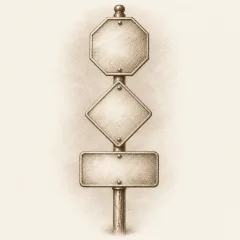
Chapter 4: Traffic signs, signals and pavement markings
Tennessee sign colors and shapes, regulatory, warning, work zone, railroad and guide signs, traffic lights and arrows, pedestrian and lane control signals, and the meaning of every common line on the road.
Why this chapter matters
Traffic signs and signals make up about 25 percent of the Tennessee knowledge test, per the 2022 manual edition. Learn shapes and colors first: they tell you what a sign means even when it is dirty, damaged or too far away to read. Always obey directions from police, construction flaggers and school crossing guards, even when they differ from the lights and signs.
Sign colors
| Color | Meaning |
|---|---|
| Red | Stop, yield, do not enter, wrong way |
| Black and white | Regulatory signs: laws and rules |
| Yellow | General warning |
| Orange | Construction and maintenance |
| Fluorescent yellow-green | School zones and pedestrian areas |
| Fluorescent pink (coral) | Incident management, such as crashes, spills or floods |
| Green | Guide and direction information |
| Blue | Motorist services and information |
| Brown | Public recreation and cultural sites |
Sign shapes
- Octagon (8 sides): STOP, always red with white letters. It is the only eight-sided sign.
- Triangle (pointing down): YIELD. Slow down and give way to traffic and pedestrians; stop if you must.
- Round: railroad crossing ahead. Slow down and be ready to stop.
- Crossbuck (broad X): marks the exact spot where the tracks cross. A plate below shows the number of tracks when there are two or more.
- Diamond: a hazard or unexpected condition ahead.
- Pennant (sideways triangle): no passing zone, on the left side of the road.
- Rectangle: regulatory rules and some guide signs.
A red circle with a slash means no: no trucks, no bicycles, no left turn, no U-turn. A red ALL WAY plate under a STOP sign means every direction must stop.
Regulatory signs
- STOP: stop completely before the stop line or crosswalk. If you still cannot see, edge forward to where you can and go only when safe.
- DO NOT ENTER and WRONG WAY: you are facing the wrong direction on a one-way road or ramp.
- Speed limit signs show the maximum, a minimum, or a change. A school speed limit sign with flashing yellow lights applies while children are on their way to or from school.
- Lane control signs tell you which lanes must turn or go straight, or which lanes certain vehicles must use.
- A sign telling slower traffic to keep right means use the right lane except to pass or turn left. Never straddle lanes.
- HOV signs reserve lanes for buses and vehicles with the minimum number of people shown.
- Standing in the road to ask for a ride is illegal in Tennessee.
Warning signs
Warning signs are yellow diamonds unless they are work zone (orange) or school (yellow-green) signs.
- Turn sign: a sharp turn, usually with a recommended speed of 30 mph or less.
- Curve sign: a curve with a recommended speed between 30 and 55 mph.
- Reverse turn: two turns in opposite directions less than 600 feet apart.
- Stop ahead, yield ahead, signal ahead: the sign or signal is hidden from view; start slowing now.
- Lane ends / merge left: your lane is ending; signal and merge.
- Merging traffic: traffic is joining from the side; move over if you safely can.
- Advisory speed plate: a small plate under a warning sign showing the recommended maximum safe speed.
- Falling rocks: watch the road for rocks already fallen.
- Low clearance: the height from the road to the bottom of a bridge or overpass.
- T-intersection: your road ends; turn left or right and be ready to yield.
- Chevrons: a sharp change in direction.
Work zones and flaggers
Work zone signs are orange with black letters or symbols. Barricades, panels, drums and cones guide you through: stay in the middle of your lane, obey the posted limit and do not change lanes until you are clear of the zone. Flaggers use STOP/SLOW paddles, or red flags in emergencies; obey them. Flashing arrow panels mean a lane is closed ahead, so merge early.
Other signs and markers
- Slow-moving vehicle emblem: an orange triangle with red borders on tractors, machinery and horse-drawn vehicles.
- Interstate route marker: a blue and red shield. U.S. route markers have black numbers on a white shield.
- Guide signs on interstates are green with white letters. If a guide sign shows an exit-only panel, every lane under the arrows must exit.
- Blue service signs point to gas, food and lodging. The blue accessible parking sign reserves a space for vehicles with a disabled plate or placard.
- Object markers flag bridge ends and other obstructions next to the road.
- Emergency reference markers on busy urban interstates are placed every 1,000 feet. They show the route, direction and mile to the tenth, so you can tell 911 exactly where you are.
Railroad crossings
Flashing lights on a crossbuck mean a train is coming: stop and stay stopped until it passes. If there are gates, stop when the lights start flashing and before the gate comes down, and stay until the gates are up and the lights stop. With two or more tracks, a passing train can hide a second one. Never try to beat a train.
Traffic signals
- Green: go if the intersection is clear. Yield to pedestrians and vehicles still in the intersection, and to oncoming traffic when turning left.
- Yellow: the light is about to turn red. Stop if you safely can; do not speed up. If you are already in the intersection, continue carefully. Tennessee law requires the yellow to show for at least 3 seconds.
- Red: stop behind the crosswalk or stop line. Unless a sign forbids it, you may turn right on red after a complete stop when no pedestrians or cross traffic are present. A left on red is allowed only from a one-way street onto a one-way street going left.
- Flashing red: same as a STOP sign.
- Flashing yellow: slow down and go ahead with caution.
- Green arrow: a protected turn in the arrow's direction, after yielding to anyone already in the intersection.
- Flashing yellow arrow: you may turn left after yielding to oncoming traffic and pedestrians.
- Red arrow or red light in your lane: no turns, even if other lanes have green.
- Signal not working: treat the intersection as an all-way stop.
Never start into an intersection to turn unless your path is clear, and never "jump the green" or try to "beat the yellow".
Pedestrian signals
WALK (or a walking person) means pedestrians may start across. DON'T WALK (or a raised hand) means do not start. Watch these signals to predict when people will step out.
Lane control signals
| Signal over the lane | Meaning |
|---|---|
| Green arrow | You may drive in this lane |
| Red X | Do not drive in this lane |
| Steady yellow X | The lane's direction is changing; move out of it safely |
| Flashing yellow X | The lane is for turning only |
Pavement markings
- White lines separate lanes going the same direction; yellow lines separate traffic going in opposite directions.
- A solid white line marks the right edge; a yellow line marks the left edge of the lanes going your way. If you ever have yellow on your right and white on your left, you are going the wrong way.
- Broken yellow: you may cross to pass when it is safe.
- Double solid yellow: no passing from either side, though you may cross to turn into a driveway or side road.
- Solid and broken yellow together: you may pass only if the broken line is on your side.
- Broken white: you may change lanes when safe. Solid white: stay in your lane. Do not cross a double solid white line.
- Turn arrows: a curved arrow with ONLY means you must turn that way; a curved and straight arrow means turn or go straight.
- Crosswalks and stop lines show where to stop. Without a stop line, stop before the first crosswalk line, or before your bumper crosses the edge line of the cross street.
- A white X with RR painted on the road warns of a railroad crossing.
- A diamond in the lane marks an HOV lane.
Frequently asked questions
What should I do if the traffic light is out?
Treat the intersection as an all-way stop: stop, then go in turn when it is safe.
What color are school zone signs?
Fluorescent yellow-green, which is easy to see in low light, fog and rain.
Can I turn left on red in Tennessee?
Only from a one-way street onto another one-way street with traffic moving left, after a complete stop and unless a sign forbids it.
Based on the 2022 edition of the Tennessee Comprehensive Driver License Manual (Tennessee Department of Safety and Homeland Security, Section B-3), archived by the Tennessee State Library and Archives. The current edition on tn.gov could not be checked.