
Hawaii · Handbook chapter 5 · 3 min read
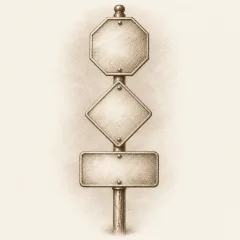
Chapter 5: Traffic signs and work zones
Hawaii sign colors and shapes, STOP and YIELD, speed and lane use signs, no-passing signs, exclusion signs, warning signs, guide signs and construction zone devices and flaggers.
Why this chapter matters
Sign pictures appear on the test, and you are expected to know a sign from its color and shape as well as its words or symbol. Our practice sets put five sign-picture questions in each test.
Colors
| Color | Meaning |
|---|---|
| Red | An action is prohibited; used on signs of several shapes |
| Yellow | Warning of hazardous conditions; almost always a diamond |
| Orange | Warning about road work; rectangles or diamonds |
| Black and white | A required action; always rectangular |
| Green, blue, brown | Guide and information signs, mostly rectangular |
Regulatory signs
- STOP: eight-sided, white on red. Stop completely at the stop line, or before any marked or unmarked crosswalk, and yield. If you cannot see from there, move ahead slowly and stop again where you can see.
- YIELD: red and white triangle. Be ready to stop; you must stop only if traffic with the right-of-way is present.
- SPEED LIMIT: black and white rectangles showing the maximum and sometimes a minimum speed, or special limits for certain times, conditions or vehicles.
- Reduced speed ahead: gives advance notice; the new limit begins at the next speed limit sign.
- Lane use control: show the turns required or allowed from each lane; move only as shown for your lane.
- DO NOT PASS: no passing on two- and three-lane roads where posted.
- NO PASSING ZONE: a yellow and black pennant on the left side of the road, pointing to the start of the no-passing zone.
- PASS WITH CARE: marks the end of a no-passing zone.
- Alignment signs (such as keep right): show where you must drive around an island or obstruction.
- Exclusion signs: a red circle, or a red circle with a slash, banning a vehicle, a movement such as a turn or U-turn, or an activity.
Warning signs
Usually yellow diamonds with a black symbol or words. The manual's examples include a hill, a divided highway and the end of one, a slippery road, a pedestrian crossing, a lane that ends or a narrowing road, a traffic signal ahead, and the five-sided school sign, which can mean either a school crossing or a school zone.
Guide and information signs
These show route numbers, places and distances, parks and recreation, and services.
Construction and maintenance zones
Orange is the basic color for work zone devices: signs, barricades, drums, cones, tubes, flashing arrow panels and flaggers.
- Most work zone signs are diamond shaped; a few are rectangles.
- Channelizing devices guide you through, and often carry lights at night. Diagonal stripes sloping down to the right mean bear right; sloping down to the left, bear left.
- Flashing arrow panels guide you into a lane and tell you part of the road ahead is closed.
- Flaggers dress in high-visibility clothing and direct drivers with red flags or STOP/SLOW paddles. Do what they signal.
Frequently asked questions
What shape and color is a STOP sign?
An eight-sided sign with white letters on red.
Where is the NO PASSING ZONE pennant placed?
On the left side of the road, pointing to where the no-passing zone begins.
What does a red circle with a slash mean?
The vehicle, movement or activity shown inside it is prohibited.
What color are road work signs?
Orange.
Based on the Hawaii Driver's Manual (2023 edition), Chapter VI: Traffic Signs, Signals and Markings.