
Vermont · Handbook chapter 5 · 5 min read
Chapter 5: Traffic lights, road signs and highway markings
Vermont traffic signals and arrows, sign shapes and colors, warning and regulatory signs, center lines and lane markings, work zones, flaggers and railroad crossing rules.
Why this chapter matters
The DMV's tests are meant to check that you can read and understand the signs and lights on the road. Sign shapes, signal meanings and railroad rules appear on almost every practice set.
Traffic lights
- Dark signal (power failure): stop as if there were STOP signs in all directions.
- Steady red: stop before the stop line or crosswalk, whichever comes first, and wait for green. A right turn on red is usually allowed after a full stop, a scan of the intersection and yielding, unless a sign forbids it. A police officer may direct you through a red light.
- Yellow: the light is about to turn red. Go through with caution only if you are too close to stop safely.
- Green: go if safe. Turning left, yield to oncoming traffic.
- Flashing red: like a STOP sign. Stop and yield to everyone.
- Flashing yellow: slow down, scan and proceed with caution.
Arrows
- Solid red arrow: do not enter the intersection to turn; stop and wait.
- Solid yellow arrow: the turn arrow is about to turn red.
- Flashing yellow arrow: you may turn left after yielding to oncoming traffic, which has a green light, and to pedestrians.
- Solid green arrow: your turn has the right-of-way; oncoming traffic has a red light.
Road signs
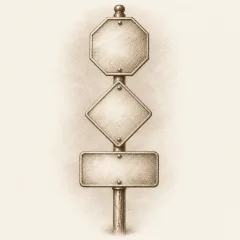
You can tell a sign's meaning by its shape and color as well as its words, which helps when a sign is covered by snow or dirt.
- STOP: 8 sides. Stop before the stop line, the crosswalk (marked or unmarked) or the intersecting road, whichever comes first.
- YIELD: upside-down triangle. Slow down, search, and enter only when the way is clear.
- Railroad advance warning: round, with a large X and the letters RR.
- Crossbuck: at every railroad crossing. A smaller sign below shows the number of tracks; with two or more tracks, one train can hide another.
- Slow-moving vehicle: a triangle with the points cut off, orange and red, on the back of farm and other slow vehicles.
- Warning signs: usually diamond-shaped, yellow or green, for curves, intersections, dips, school zones, deer crossings, slippery roads, hills and lanes that end. A downward arrow under a school or pedestrian sign marks the crossing itself.
- Regulatory signs: rectangular with white backgrounds, telling you what you must or must not do, such as speed limits and turning and passing rules.
- Work zone signs: orange, diamond or rectangular.
Highway markings
- Yellow center lines separate traffic moving in opposite directions. Multilane roads without a median use double solid lines.
- A broken white line separates lanes moving in the same direction.
- Solid or double solid line: do not pass. Broken line on your side next to a solid line: you may pass when clear. Solid line on your side: do not pass.
- A two-way left turn lane is only for turning, not traveling. Move all of your vehicle into it a short distance before the turn.
- A yield line is a row of white triangles pointing at approaching cars, showing where to stop if you must yield.
- In a lane with a straight arrow, it is illegal to turn at the intersection. Stay in your lane through a turn and change lanes only afterward.
- On a divided highway, if the edge line on your right is yellow, you are going the wrong way.
Work zones
- Rules apply 24 hours a day. Fines are doubled for speeding in a work zone.
- Most work zone crashes are rear-end crashes caused by speed and following too closely. Keep a 4-second gap: a car at 60 mph needs about 240 feet to stop on dry pavement, compared with 75 feet at 30 mph.
- Merge as soon as it is safe, do not change lanes inside the zone, and give workers room.
- A flagger has legal authority to control traffic and must be obeyed. Flashing arrow panels in "caution" mode mean slow down.
- In temporary markings, yellow should be on your left; if not, you are in the wrong lane.
- If your wheels drop onto a low shoulder, slow down without braking and steer back carefully at low speed.
Railroad crossings
- Never drive through, around or under a closed gate, and never pass another vehicle at a crossing.
- Stop at least 15 feet from the nearest rail when lights flash, gates are down or a flagger signals, when you see or hear a train, or at a STOP sign. Cross only when safe.
- If a crossing is unsafe, call the number on the emergency sign and give the crossing number.
Frequently asked questions
What should I do if a traffic signal is completely dark?
Stop as if there were STOP signs in every direction.
What shape are warning signs?
Usually diamond-shaped, and yellow or green. Work zone signs are orange.
How close to the tracks must I stop when a train is coming?
At least 15 feet from the nearest rail.
What does a flashing yellow arrow mean?
You may turn left after yielding to oncoming traffic, which has a green light, and to pedestrians.
Based on the Vermont Driver's Manual (VN-007, 2025) and the Vermont DMV Learner's Permit page.